CooperAitken Admin

The 2025 Dairy season has set off with a bang!

The 2025 dairy season has set off with a bang! The lift in the farm gate milk price to $9.00 kg/ms, with a range of $8.25-$9.75 kg/ms has brought about some welcome confidence to the industry and our farmers. Alongside this increased payout, many farms started in a positive position for 1 June 2024 with improved cow condition, good pasture covers, and feed on hand.   $7.20 kg/ms is the advance rate that Fonterra farmers are receiving for milk solids supplied in October and paid in November. Compared to last year’s rate of $5.45 kg/ms, the $1.65 per kg/ms increase will provide a meaningful impact to farmers’ cash flow. For the average sized 100,000kg farm that equates to an extra $165,000 cash that will be received on 15 November 2024 when directly compared to the same time last season. Tax on this at the company tax rate of 28% is $46,200 in forecast additional tax. This is before factoring in any interest rate reductions or production increases, meaning taxable profits are forecast to be up significantly which is fantastic news for our farmers. With the increased cash flow, some farmers are considering or have recently repaid a lump sum debt payment to their bank. A lump sum payment may seem like a great idea today, but it is important to consider what does the bank account balance look like heading into winter 2025? Will there be enough cash to pay the additional 28 June 2025 provisional tax? To answer these questions and provide some clarity on cashflow, we recommend a 12-month cash flow forecast.  A forecast cashflow provides an opportunity to; Forecast the closing bank balance on 31 May 2025 Forecast cash movement position and compare to last year Forecast the 28 June 2025 provisional tax payment to account for any extra tax Plan for debt repayment Identify break-even milk price, farm working cost per kg/ms and benchmark against industry averages Another welcome change in the payout is the advance rate which is at $7.60 and not forecast to change until July 2025. What this means is a Farmer will not have any catch-up payments or larger milk cheques running through these months, which is very different to the past seasons and another good reason to complete a cash flow forecast to understand how this impacts your farm and your cash flow. A forecast cashflow is a key decision-making tool and in this season, more important than ever. The forecast seeks to use information we know today to plan.With farming we know it is never going to be exact because of the external influences on the business. However, it is a proactive way to provide some certainty on cashflow and tax position to avoid any end of season surprises!   Amy CoombesPartner P: 07 889 7153E: amyc@cooperaitken.co.nzM: 027 715 2728 return to all blogs

The 2025 Dairy season has set off with a bang! Read More »

Trust Changes

Trust Changes The law of Trusts has undergone a significant update in the past few years. Firstly, the Trusts Act 2019 came into effect in January 2021. The new Act reformed Trust law and brought it up to date by providing mechanisms to resolve trust disputes, providing Trust administration rules, setting out core trust law principles and aims to make Trust law more accessible and transparent. Key changes included introduction of clearly stated trustee duties, extending the maximum trust duration to 125 years and setting out the presumption of disclosure of Trust information to beneficiaries. Additionally, new Taxation legislation came into effect in December 2020 regarding disclosure requirements for Trusts for tax purposes. Since April 2021 most Trusts are now required to provide Inland Revenue with annual financial reporting. This financial reporting includes a statement of profit and loss, a balance sheet and any other information as specified by Inland Revenue. More recently the trust income tax rate has been raised from 33% to 39% for the 2024–25 income year and beyond. Along with this change there are some specific new rules required to mitigate potential over-taxation. The most beneficial will be that the 33% rate will still apply to trustee income that does not exceed $10,000 after deductible expenses. Additionally, there are targeted rules for trusts related to deceased estates and those established for disabled individuals, as well as exclusions for energy consumer trusts and legacy superannuation funds. Furthermore, the change also introduces a measure to reinforce the new 39% rate by applying it to beneficiary income derived from certain close companies. This adjustment ensures that income from these companies will also be taxed at the 39% trustee rate, aligning with the updated tax policy. It is worth noting that for Beneficiaries the tax thresholds remain unchanged for income from $78,100 up to $180,000 to be still taxed at the 33% rate. But careful attention is needed regarding the minor beneficiary rule and the $25,000 deemed settlor rules also. For Portfolio Investment Entity (PIE) investments, a 28% tax rate will remain in effect meaning with some tax planning opportunities the impact of the 39% rate could be mitigated to some extent. These changes have generally prompted a comprehensive review of Trusts, their administration, financial reporting, purpose and future. If you’d like to discuss your Trust administration and/or financial reporting requirements please get in touch with our dedicated Trust, Governance & Companies team. Written by Megan Potter and Rory Noorland. Megan PotterPartner, LLB  P: 07 889 7153E: meganp@cooperaitken.co.nzM: 027 370 4329 Rory NoorlandPartner, CA P: 07 889 7153E: rory@cooperaitken.co.nzM: 021 721 368 Returns to blogs

Trust Changes Read More »

Looking Beyond Fines

Looking Beyond Fines. Unlocking the benefits of Farm Compliance. In today’s evolving agricultural landscape, farm compliance is more than just a regulatory requirement. It’s considered a strategic investment in your business’s long-term success. While non-compliance can lead to significant financial penalties, it’s important to recognise the broader benefits that compliance can offer. By prioritising compliance, there is potential to enhance your farm’s profitability, reputation, and sustainability. Financial Gains Enhanced Access to Financing: Lenders are increasingly recognising the importance of compliance. By demonstrating your commitment to responsible farming practices, there is potential to improve your chances of securing loans at more favourable interest rates. Premium Payments: Some farm assurance programs offer premium payments to farmers who meet their compliance standards, which can provide a boost to your income. Increased Property Value: Farms with strong compliance records can often be valued higher in the market. This is because they demonstrate a commitment to sustainable practices and reduced risk, making them more attractive to potential buyers. Ethical and Sustainable Farming Positive Reputation: Compliance with ethical and sustainable practices contributes to the positive image of our industry and strengthens the ability to negotiate for better markets. Contribution to a Sustainable Future: By adhering to environmental regulations and ethical guidelines, you contribute to a more sustainable and responsible agricultural sector. This can help protect our natural resources and ensure a healthy future for generations to come. Improved Safety and Well-being Safer Work Environment: Compliance with health and safety regulations helps create a safer and healthier work environment for your employees, reducing the risk of accidents, injuries, and associated costs. Employee Satisfaction: A positive and safe work environment can lead to increased employee morale, productivity, and job satisfaction, which can contribute to a more efficient farming operation. Farm compliance is not just about avoiding penalties; it’s about unlocking a range of benefits that can significantly enhance your business’s success. By prioritising compliance, you could improve your farm’s financial performance, enhance New Zealand’s reputation, contribute to a more sustainable future, and create a positive and rewarding work environment.

Looking Beyond Fines Read More »

Passion for supporting Dairy Farming

Passion for supporting Dairy Farming CooperAitken are extremely passionate about our communities and taking pride in getting involved and supporting in any way we can. One of the many ways we are involved in supporting the agricultural industry is through the  Waikato New Zealand Dairy Industry Awards, as a sponsor, as well as many team members having held the role of Treasurer for the Waikato Committee. Having grown up in the Waikato and being immersed in the agricultural industry, I have always been passionate about it. I was thrilled to take on the role of Treasurer for the Waikato region and be part of this incredible program. There is no doubt about the value the dairy industry brings to New Zealand, and to be able to support an awards program where entrants are extraordinary ambassadors, showing their passion for and dedication to the industry, is a great program to be involved in. The New Zealand Dairy Industry Awards have been a benchmark of the industry, celebrating innovation, achievement, and the best of dairying in New Zealand since 1989. Annually the awards have a number of events co-ordinated over 11 different award regions leading into the national awards finals. The events provide the opportunity of collaboration between farmers, industry specialists and key support businesses, providing many learning opportunities, whether you’re involved as an entrant, judge, sponsor, or part of the committee. It is a great way to connect with like-minded people who are passionate and positive about the future of the dairy industry. Not only do the awards offer incredible prizes, many entrants also credit the awards for having a huge impact on their careers, adding value to their CV, building connections, progressing in the industry, and connecting with mentors. Sharefarmers also find significant benefit from learning more about their farming business through the in-depth judging criteria. There are Four Awards Categories: Dairy Trainee of the Year Dairy Manager of the Year Share Farmer of the Year Responsible Dairying Award More information about each category can be found here. The judging process takes place over a number of weeks, tailored specifically for each category. Dairy Trainee entrants are judged at a group a skills day involving hands-on practical skills and general knowledge. Dairy Manager and Share Farmers consist of organised farm visits by the judges to assess a number of areas including, pasture and feed, livestock, farm environmental and sustainability, people and culture. The New Zealand Dairy Industry Awards encourage farm owners and employers to encourage their team to enter. The benefits to yourself and team are endless: Empowers your team, improving confidence in themselves and the industry. Assists in personal development, setting people up for their next step in their career. Giving the next generation drive for the dairy industry, by being surrounded by positive advocates. Networking with like-minded individuals as well as regional and national sponsors Skills and knowledge are developed: the judging criteria covers every aspect of farming, benefitting the entrant to seek the understanding and guidance from the farm owner. Having been involved in the awards program for a number of years, we have witnessed its positive impact on all participants and winners. If it holds some interest, we strongly encourage you to enter. Entries Open: 7 October 2024Entries Close: 8 December 2024 Questions? Touch base with the Waikato Dairy Industry Awards team!Regional Managers Cameron & Nicola van Dorsten – email here. Dairy Industry Awards – Waikato Images left to right: Waikato 2024 Winners, Louise awarding CooperAitken Award, Winner of CooperAitken award & Louise.   Louise Maxwell-Granich, BAM CAClient Manager + Senior Accountant P: 07 888 8002E: louise@cooperaitken.co.nz

Passion for supporting Dairy Farming Read More »

Let’s talk ACC Employer Invoices

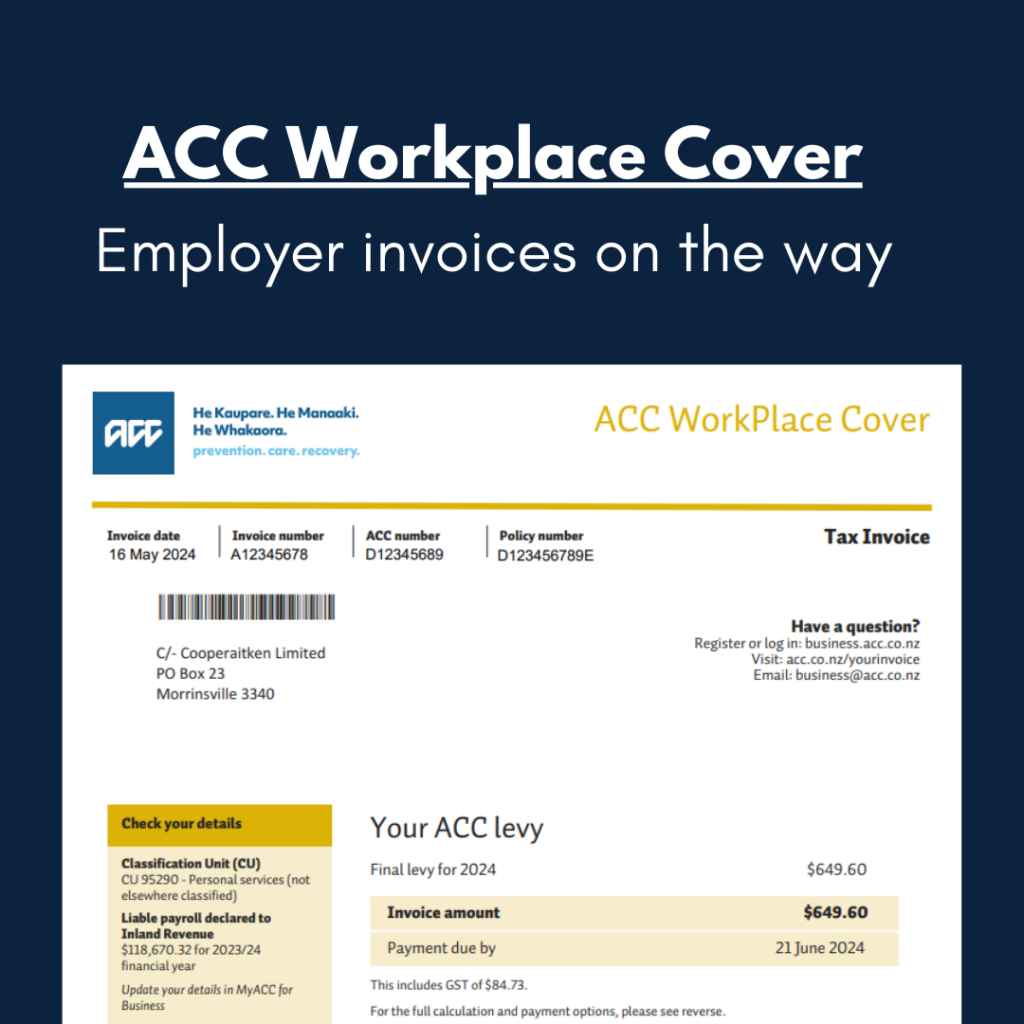
Let’s talk ACC Employer Invoices Do you employ staff? It’s that time of the year and if you have employees, you will receive an invoice  from ACC.  All businesses will pay employer levies to ACC to cover the cost of all work-related accidental injuries.   These levies go towards treatment and rehabilitation so your employee can get back to work as soon as possible.  Your levies are generated based on the following: Classification Unit Your company is assigned a classification unit which aligns with different industries and these units have different levies on risks.   These classifications are represented by your BIC code (Business Industry Classification).  This code would align with your main work activities when you register for GST or submit a tax return.  Your chosen classification unit is grouped with other similar businesses so ACC can distribute the cost of injuries equally. Liable Earnings Your liable payroll is how much you pay your employees.  Holiday pay and overtime are all included in your liable payroll – but redundancy and retirement payments are not.  This figure will all depend on how much you pay your employees. Experience Rating This rating is based on the number of work-related injury claims your business has submitted.  If this has been added to your invoice, you’ll find it in the calculations section on the back of the invoice.  Here’s a handy glossary of terms that may help you understand the finer details of employer levies: Final LevyBased on your total liable payroll for the year-end or wash up of the previous year using details received from Inland Revenue.  Provisional Levy An estimate invoice based on the payroll from the previous year with adjustments made for expectations such as salary increases. Earners LevyMuch like tax you’ll deduct ACC Earners’ Levies from your employees’ wages as part of their PAYE payments.  This levy covers them for injuries that happen outside of work e.g.  Whilst playing sports or at home.  Workers Levy  The Workers Levy covers your employee if they injure themselves whilst at work.  For this type of scenario, you will need to pay them their first week of wages.  Working Safer LevyThis levy is collected on behalf of WorkSafe New Zealand and is a fixed rate per $100 earned for every levy payer in New Zealand.    It goes towards supporting WorkSafe’s activities and injury prevention across the country. What can we do to help? Did you know, if you paid an employee’s first week of weekly compensation from a workplace accident, we can inform ACC so they can adjust the income used to calculate your levy which may reduce how much you need to pay. You can also let us know whether your payroll will be increasing or decreasing significantly in the future. This ensures your not under or overpaying your levies unnecessarily.  Ceased or ceasing payroll? Its important to let ACC know if you are discontinuing to employ staff. We can ensure this process is completed properly using the correct procedures and information from IR. If your business activity has changed, we need to know. Ensuring your levies are calculated correctly is paramount as well as the risk of interfering with claims made by your employees in the future potentially. Noticed your experience rating is high? This rating impacts your Work levy by considering historical claims and your health and safety performance.    ACC is here to support you by helping to explain in more details on how your experience rating affects your levy and having a conversation about your claims performance and how you might be able to improve it. Got a burning ACC question? Flick us an email or give our friendly team a call 07 889 7153. email acc team

Let’s talk ACC Employer Invoices Read More »

Evidence of Compliance

Evidence of Compliance Be Audit ready: Streamline Evidence Collection for your farm Running a farm requires juggling many responsibilities, and compliance can feel like another burden.  But what if you could transfer audits from stressful events to smooth demonstrations of your commitment to best practices.  The key lies in having a well-organised system for evidence collection. Why evidence collection matters? Imagine a WorkSafe investigation after a farm incident, your upcoming dairy shed assessment, or an audit for your Farm Environment Plan or the new sustainability loans offered by some banks. In these situations, documented evidence is key to demonstrating your adherence to standards and regulations and will ensure a smooth process. Compliance evidence is often scattered over various farm sources.  Policies, training records, incidents reports – the list can be overwhelming.  Checkbox can help, with our structured approach to evidence collection. Building a Robust Compliance Program: The Power of Evidence Effective evidence collection is the backbone of a strong compliance program. By proactively gathering and organising documentation, you’ll save time and stress during audits. Here’s what your evidence collection should include: Policies: Policies declare your farms commitment to compliance. Standard Operating Procedures (SOPs): SOPs detail how tasks are completed compliantly. Past Audit Reports: These demonstrate how you’ve addressed previous non-compliance issues and implemented improvements. Training records: Prove your employees are well informed and understand relevant regulations. Response Plans: Be prepared for emergencies and have documented plans for effluent management. Risk Assessments (GAP analysis): Identify potential compliance weaknesses and establish best practices to address them. Supporting documents: Invoices, meeting minutes, and other records can fill in the gaps and provide a complete picture. Be Audit Ready, All Year Round. At Checkbox we offer: A comprehensive list of compliance documents. Ensuring you have everything you need. GAP analysis support: Identify and address compliance gaps proactively. Checklists: Guidance on how to meet compliance requirements and what documentation to collect throughout the year. Regular Check-ins: Stay on track with quarterly reviews to maintain compliance readiness. Ongoing support: We’re here to answer your questions and provide guidance on any compliance gaps identified. Consistent evidence collection empowers you to face any audit or investigation with confidence. Contact Checkbox today to streamline your compliance journey. read more about checkbox

Evidence of Compliance Read More »

Tax threshold changes are here!!

They’re here!! Tax Threshold Changes – 31 July 2024 On the 30th May 2024, the Government announced new tax thresholds, from 31st July 2024. Previously, it was indicated these changes would take place 1st July 2024, and this date was amended at announcement. What do these changes mean for you and your payroll? The new thresholds have been confirmed, and have been published on the IRD website as follows; This impacts directly on PAYE values. All wages and Salary payments made on and after 31st July 2024, must have PAYE calculated using the new rates. Pay cycle is not the indicator of which tax tables to use, the pay date leads this. See the example for a weekly payroll below; Example 1: Works Monday to Friday. Is paid the following Tuesday. Worked from 22 July to 26 July. The pay date is 30 July. New tax threshold are not used. Example 2: Works Monday to Friday. Is paid the following Tuesday. Worked from 29 July to 2 Aug. The pay date is 6 Aug. New tax threshold will be used. There are also some components that are not changing until 1st April 2025. Extra Pays. Calculating extra pay will still use present tax thresholds and won’t change until 1st April 2025. Employees may question this, as they may expect less tax to pay. So be prepared to answer why this has not changed. Use what IRD has stated; Using the new thresholds may create underpayment of tax. Any issues will be sorted out at the end of year assessment (square-up) Extra pays include Annual Leave cash ups, Annual & Special bonuses, back pay and lump sum holiday pays (Annual leave paid in advance/beginning of leave period) Employer Super Contribution Tax (ESCT) This will not change on 31 July 2024. It will change on 1 April 2025 to reflect personal income tax threshold increase. What to tell Employees. Be proactive, rather than reactive. Get information on changes to employees before 31 July so payroll does not get flooded with questions. Employees will be looking for additional money, so will question any payment they believe should have been taxed at a lower rate with the new thresholds (such as extra pays, as already addressed in this notice) As an example, if you have an annual bonus paid to employees after 31 July 2024, provide employees with information on how this is taxed. Use IRD references as much as possible, to back up what you are doing. Link to IRD – Personal Income Tax Changes https://www.ird.govt.nz/pages/campaigns/personal-income-tax-threshold-changes Employee needing to change their tax code. The employee must decide if they need to change their tax code based on the changes that will occur on 31 July 2024. Unless Payroll or the employer receives instruction from IRD. Payroll and/or the Employer must not involve themselves in advising an employee what tax code they should be using. Payroll and/or the Employer must not act as a financial advisor for the employee. If that occurs, and the advice is not correct, it makes the employer liable for any error. Payroll and/or the Employer can only access information regarding what they pay to the employee, so it is not possible to know all their personal financial information If the employee asks for help, this is what Payroll and/or the Employer can do; Direct them to the current IR330 and explain there is step by step guidance on that document. Direct them to the IRD website https://www.ird.govt.nz/income-tax/income-tax-for-individuals/tax-codes-and-tax-rates-for-individuals/tax-codes-for-individuals Or they can call IRD directly https://www.ird.govt.nz/contactus Our payroll team have undertaken the necessary training, and have obtained the resources required to ensure accurate wage calculations, so our clients can update their payroll information and provide employees with the right information prior to the changes on 31st July 2024. If you are processed wages client, we will be emailing and posting wage calculations over the coming weeks. We will also be contacting our established advisory clients. If you have not used our Payroll services in the past, and require assistance in getting this right for your employees, email us on: wages@cooperaitken.co.nz We are happy to help! back to all blogs Written by Jane SmithPayroll Team Lead P: 07 889 7153E: wages@cooperaitken.co.nz 

Tax threshold changes are here!! Read More »

A much anticipated change to Income Tax Rates – a payroll perspective.

A much anticipated change to Income Tax Rates – a Payroll perspective. On 9th May 2024, The Hon. Nicola Willis reiterated the Government position on delivering income tax reduction for working New Zealanders. The last time changes in income tax thresholds took place, was 1st October 2010*. Whilst tax relief is most welcome in this current economic climate, the timing of implementation brings some questions. Wage calculations – again? Many of our wage’s clients will recall the changes made 1st April 2024, when minimum wage increased and ACC Earner levy was raised to 1.6 cents in the dollar. Clients can expect similar wage calculation activity, to show the changes required to net payments, to reflect the changes in their PAYE deduction figure. This is a cost to your business. What are the new threshold’s? As previously reported by our own Gerrie Jacobs (March 2024) we have only been given proposed threshold figures, the announcement of the new rates is due today at 2pm. Once announced, Inland Revenue, Payroll service providers and software developers will have a very small window in which to enact these changes (as prior to this announcement, our team has not been in a position to provide accurate calculations). Seems straight forward – why do I need further wage calculation’s for my employees? Unfortunately, these changes come with levels of uncertainty. When tax rates are changed part way through a year (as is happening this year), an average of the new and old rates are applied across the entire year to determine a person’s annual tax liability. The average tax rates are called composite rates. Having a composite tax year will bring another component of complexity to the situation. It is also fair to note that other payroll components will be affected. Employer Superannuation Contribution Tax (ESCT) and Prescribed Investor Rates (PIR) will have changes that directly correspond to the changes in thresholds. If these calculations are not administered correctly, your employee’s deductions may be incorrect. So what do I need to do? If you use an external payroll service provider, such as ourselves, you can expect the following, as per your applicable payment scenarios: Automatic payments (Salaries and standard pays) – we will provide you with an updated wage calculation prior to your first payment date after the changes come into effect. Hourly rate wages (also referred to as ‘Live’ wages) – our software partners will have updated the system. We will apply additional vigilance when the first pays are calculated, to ensure the updates have loaded correctly and the outcome is in line with expectations. If you are managing your own payroll, and would like an independent review of your processes, or a fresh calculation to move forward with – please reach out. Our friendly team are on hand to provide support and advice. Our main contact details are; Phone: (07) 889 7153 – ask for Payroll Division.Email: wages@cooperaitken.co.nz [*] Source https://www.parliament.nz/media/7523/library-research-brief-income-tax-rates-december.pdf —————————————————————– Written by Jane SmithPayroll Team Lead P: 07 889 7153E: wages@cooperaitken.co.nz 

A much anticipated change to Income Tax Rates – a payroll perspective. Read More »

Here we go again…. Bright-line v4

Here we go again…. Bright-line v4 The original Bright-line test was introduced with effect from 1 October 2015 and was designed by Inland Revenue as a simple way to capture tax on property speculation.  The intention test had proven to be almost impossible for Inland Revenue to apply with speculators buying and selling houses in an ever-rising property market with some making impressive profits from doing so. The design of the test was initially on this basis: if a residential property was bought and sold within two years and didn’t fit the criteria for one of the few exemptions, it was subject to tax. Though this had some “complications” in terms of the legislation, by comparison it would never be so simple.  In the years that followed the Government of the day determined that using the tax system to drive certain economic behaviours would be the answer to what was perceived as unfairness in the area of home ownership. Cue the extension of the Bright-line to 5 years, along with some relief measures.  When this still wasn’t having the desired impact a further extension to 10 years, with even further complication as a result ensued.  What began as a simple test was pushed to such complexity, in the interest of remaining fair, that it became a whole area of expertise all on its own. The fact that the ‘Special report on interest limitation and additional bright-line rules’ ran to a whopping 216 technical pages of explanation, examples and interpretation should say it all.  So come 1st July 2024, not quite 9 years since originally introduced, we have now come full circle. And thankfully for most tax payers we can now throw out the 216 page special report as the test has returned to almost as introduced originally. If you sell a property on or after 1 July 2024 the bright-line property rule will only apply if the property is sold within 2 years of purchasing it. However, if you sell a property before 1 July 2024 the current bright-line rules still apply. The important point to note is that the end date for the Bright-line Test is the date that you enter into a sale and purchase agreement. Therefore, if you wish to apply the new two year test the agreement must be on or after 1 July 2024. There are some other taxpayer friendly changes coming. In terms of the main home exemption this will return to the much simpler 50% rule. For the exemption to apply you must: use more than 50% of the property’s area as your main home use the property as your main home for more than 50% of the time you owned it. A further win is that if you build on the land, you will now not have to include the construction period when determining if your usage of the property qualifies for the main home exclusion.  This will greatly reduce the number of taxpayers that were inadvertently caught in the bright-line test previously due to a change in circumstances. The other major simplification, and extension, is the rollover relief rules will be extended to be based on the associated person rules rather than the complicated regime we have now.  Though welcomed at the time they were not simple to apply and applied in relatively limited situations.  The following situations will now receive rollover relief under the new rules: associated companies, or a person and an associated company relatives (within 2 degrees of relationship) trusts and settlors, beneficiaries, and related trusts a partner and a partnership a look-through company and an owner of that company. These new rules will be limited to situations where the transferor and the transferee are associated for 2 years before the transfer. You will also only be able to claim rollover relief once in any 2-year period. So hopefully this will be the last time I need to write an update on the Bright-line test. The tax system works best when left to Inland Revenue policy officials in consultation with the advisor community, rather than being the political plaything for politicians with a particular ideologically-driven view of the world. As always, if you have any questions on how the legislation, new or old may affect you please get in contact with your usual CooperAitken point of contact.         ————————————————————————————————- 1st Rory NoorlandPartner + Chartered AccountantP: 07 889 7153E: rory@cooperaitken.co.nz  more on rory

Here we go again…. Bright-line v4 Read More »

ACC: Standard Cover vs CoverPlus Extra

ACC: Standard Cover vs CoverPlus Extra Love it or hate it, ACC levies are all part and parcel of making money!  But don’t fret, we are here to help guide you and create an ACC world much easier to stomach. Let’s start with the basics: Standard ACC Cover This includes the standard CoverPlus policy which covers self-employed sole traders and partners.  Standard cover also is known as WorkPlace Cover.  This policy is for Shareholders covering non-PAYE shareholder-employees. This type of cover is an automatic policy for self-employed/shareholders and PAYE earners. This cover pays out 80% of your income if you have an accident. You must prove your loss of earnings which can be difficult. Levies are calculated based on your liable earnings. CoverPlus Extra (CPX) This type of policy is optional, but displays so many more benefits: You have a Signed Agreement between yourself and ACC at an agreed value. You can choose any level of cover from $39,492 to $122,232. The cover is 100% guaranteed. You don’t have to prove loss of earnings. You receive the full entitlement until 100% fit. Provides flexibility and certainty. If you are currently covered by CoverPlus Extra, you should already know how extremely beneficial it is and how proudly its boasts a more streamline claims process, as well as flexibility to choose your own level of cover.  This in turn saves you time, money, and the feeling of satisfaction in knowing you are under the best safety umbrella should an accident occur. But here’s the catch… If you don’t pay your CoverPlus Extra policy in full or have a payment plan set up before the due date your CoverPlus Extra policy will be automatically cancelled, If your payment plan is set up and you have insufficient funds when the debit occurs, the cancellation will be backdated to the start of the policy year. Reverting to standard cover will mean your levies will instead be generated based on your liable income after your tax return, so a surprise bill might be coming your way! If your CoverPlus Extra policy does cancel, it doesn’t necessarily mean you don’t have any cover, rather that you will revert to standard cover mentioned above.  This may not provide the same level of certainty at the event of a claim taking place.  You may reapply for CoverPlus Extra again, but this will mean you go through the full application process which can be costly and time consuming. If you struggle to remember due dates, ACC offers the following payment options to better align with your budget as well knowing your payments are always on time: 3 or 6 monthly direct debit plan (interest free) One off direct debit plan (on due date) Or a manual payment in full by the due date It’s important to remember if you like to pay your invoices on the 20th of the month but your CoverPlus Extra is due prior to this there are no exceptions – ACC still require payments by due date otherwise cancellation will occur. If paying by direct debit, we have the option to change the due date to suit you and your budget, so this might suit your situation better. Every dollar saved is a dollar in your pocket for the fun stuff – so we are all about CPX for eligible candidates.  Curious? Enquire with our friendly ACC Team today for a free quote and information on how to get your hands on our most recommended ACC policy – CoverPlus Extra.  Contact our ACC Team P: 07 889 7153E: acc.morrinsville@cooperaitken.co.nz  send the team an email

ACC: Standard Cover vs CoverPlus Extra Read More »

Scroll to Top