- Home
-
-
- Payments
-
- Download our 2026 calendar
- Tax Due Dates
- Livestock Values
- Waikato Dairy Farming Benchmarking
-
- Xero Subscription Price Increases from 1 October 2026
- Is your why still showing up in your business?
- Overseas Beneficiaries: Equal on Paper, Different in Reality
- Farewell, Janet Pitkethley
- Livestock Values – What do they mean for me?
- Introducing our new Partner: Louise Maxwell-Granich
- Gavin Haddon’s Next Chapter: Farewell after 38 years with CooperAitken
- A Once-in-a-Generation Opportunity
- Trust Administration Made Easy
- Important ACC Levy Changes
- Fonterra’s Big Sale: How it could impact your farm plans
- Figured + CooperAitken Strategic Alliance
- The Quiet Strength of Planning Ahead – The Role of Wills and Enduring Powers of Attorney
- Business Health Check: Why it matters in IT field
- Inland Revenue are asking more questions
- ACC supporting safer farming
- Hubdoc: Simplifying Financial Document Management
- Trust Changes – Updated
- More payroll increases coming 1 April 2025
- The end of another financial year is fast approaching….!
- Manage your cash this summer
- Cashing up an Employees Annual Leave
- The 2025 Dairy season has set off with a bang!
- Trust Changes
- Looking Beyond Fines
- Passion for supporting Dairy Farming
- Tax threshold changes are here!!
- Evidence of Compliance
- Here we go again…. Bright-line v4
- A much anticipated change to Income Tax Rates – a payroll perspective.
- ACC: Standard Cover vs CoverPlus Extra
- Where is the coalition government at with changes to environmental regulations?
- Are you keeping up with the economy? Time for an Income Review
- What is AML + CFT?

Cashing up an employee's annual leave
Christmas is on its way and with this pending holiday comes the typical myriad of additional pressures. This is the time of year that some employees may be thinking about their leave balances and pondering if they could have some of this balance paid out in cash.
If your employee has a sufficient unused Entitled Annual Leave (sometimes called Outstanding), you can consider a request for a cash up of leave.
Why would I consider Cashing up my employees Annual Leave?
Unused Entitled Annual Leave is a liability to your business. If your employees are not using their Entitled Annual Leave, it increases debt, increases the risk to workplace safety and can indicate that some employees may not be accessing periods of rest as they should. It is recommended that you check your leave balances regularly, so you can make informed decisions regarding these matters.
It is important to note – an employer cannot force or pressure an employee to cash up leave. Nor can cash up be a condition of employment. And in a similar vein, the employer is entitled to refuse a request for Annual Leave Cash Up. Declined requests must be addressed in writing, however, an explanation for the decision is not mandatory.
How much leave can my employee cash in?
One week of Entitled Leave is the maximum that can be cashed out each year. This can be taken a few days at a time, but the total days cashed up between anniversary to anniversary cannot exceed an ordinary week.
How can I check if I can give my employee a cash up?
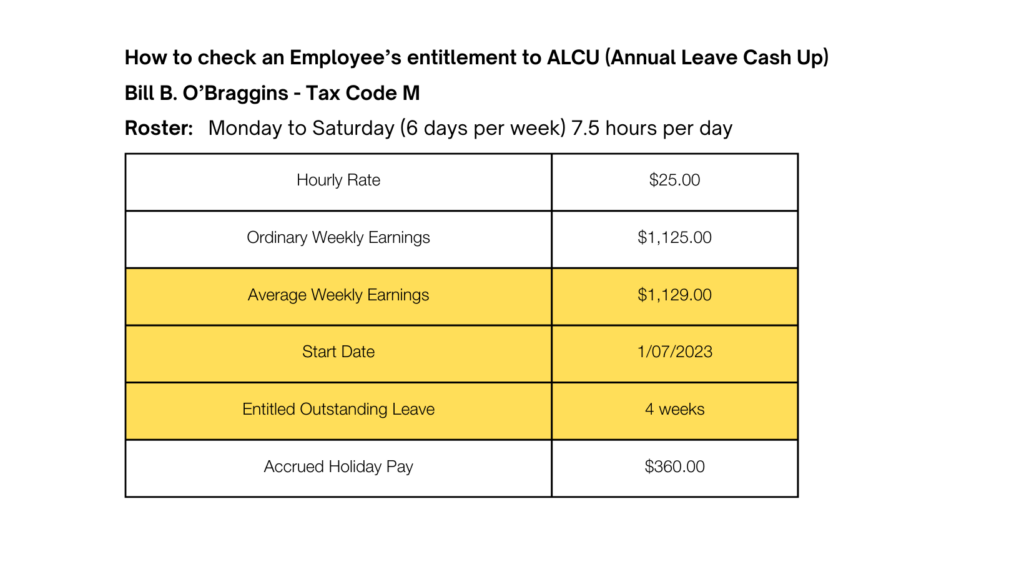
Cash ups come from Entitled Outstanding Leave balances. See below for an example of which components to look at for cash up.
(I am not addressing Kiwisaver in this example)
Using the example above – let’s explore a request to cash up 1 week of Annual Leave.
On 31st July 2024, Bill applies to cash up 1 week of his Annual Leave. Bill’s employer is happy to consider this request, but before they give Bill their response, the following is considered;
- Has Bill been employed over 12 months?
- YES, Bill started 1st July 2023.
- Does Bill have sufficient Entitled Annual Leave?
- YES. Bill has just passed his first anniversary and has his full entitlement of Annual Leave (4 weeks)
- What is a week for Bill?
- 6 Days, as per his roster.
- How much do I pay?
- Bill’s Annual Leave rate must be the higher of Ordinary Weekly Earnings (OWE) and Average Weekly Earnings (AWE). In this example, AWE is higher at $1,129 per week, therefore this is the rate to apply.
- What about the tax?
- We are going to use Bill’s M tax code for this example.
- Lump sum (extra pay) is not subject to the changes that took place 31st July 2024.
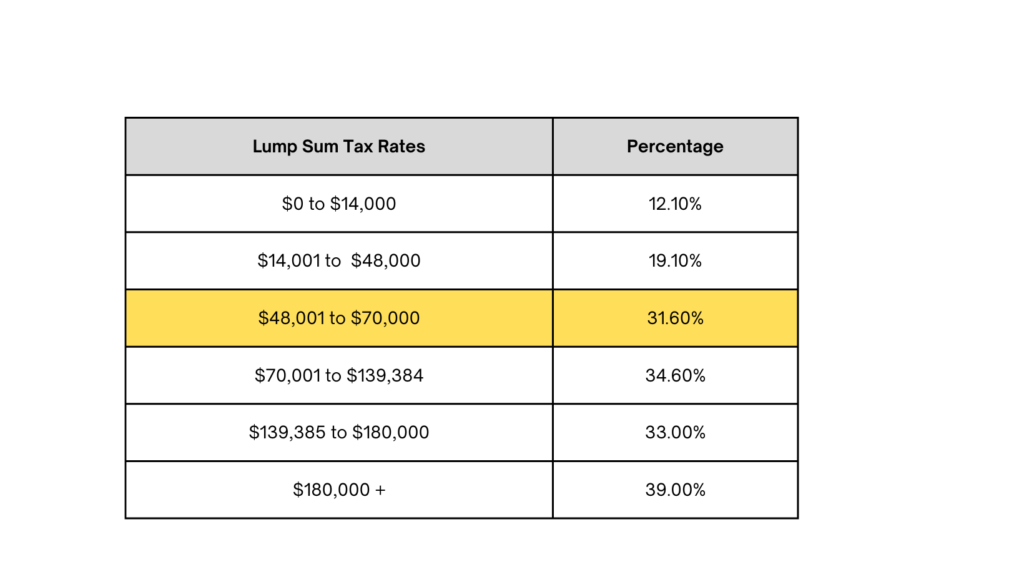
- Annual Leave cash up is taxed at Lump Sum tax rates. Selection of the correct rate is based on the annual gross earnings.
- Calculate the grossed-up annual value of the employee’s income by adding up the previous 4 weeks of income payments. (4 x $1,125.00 = $4,500)
- Bill get’s paid weekly, so multiply this number by 13 to calculate grossed up income. ($4,500 x 13 = $58,500)
- Add the lump sum payment amount ($58,500 + $1,129 = $59,629)
- From the chart below, select the appropriate lump sum tax rate
Now Bill’s employer has been able to work out the value of the Annual Leave Cash Up, they can decide if this is feasible for their cashflow at this time.
Working from the assumption that the request is approved, Bill receives his cash up in the next pay run. His ordinary earnings (wages) are taxed as per the tax tables, and his lump sum taxed at the appropriate rate. Bill’s employer also recognises that the tax amount is higher than on a usual pay, so takes the time to explain lump sum tax rates to Bill.
- Why do I need to tax at lump sum rates? Why are the tax tables not used?
- Because the cash up is an extra pay, it can push the employee’s income into the next tax bracket. Using the tax tables to calculate the PAYE payable on an Annual Leave Cash Up can result in under or over charging PAYE. This could result in a debt for your employee at the IRD and can affect the employment relationship.
Our Payroll Division can assist with Annual Leave Cash Up calculations, both in a processing and an advisory capacity.
Please reach out, we are always happy to help.
Jane Smith, Payroll Divsion Lead
Phone: 07 889 7153
Email: wages@cooperaitken.co.nz