- Home
-
-
- Payments
-
- Download our 2026 calendar
- Tax Due Dates
- Livestock Values
- Waikato Dairy Farming Benchmarking
-
- Xero Subscription Price Increases from 1 October 2026
- Is your why still showing up in your business?
- Overseas Beneficiaries: Equal on Paper, Different in Reality
- Farewell, Janet Pitkethley
- Livestock Values – What do they mean for me?
- Introducing our new Partner: Louise Maxwell-Granich
- Gavin Haddon’s Next Chapter: Farewell after 38 years with CooperAitken
- A Once-in-a-Generation Opportunity
- Trust Administration Made Easy
- Important ACC Levy Changes
- Fonterra’s Big Sale: How it could impact your farm plans
- Figured + CooperAitken Strategic Alliance
- The Quiet Strength of Planning Ahead – The Role of Wills and Enduring Powers of Attorney
- Business Health Check: Why it matters in IT field
- Inland Revenue are asking more questions
- ACC supporting safer farming
- Hubdoc: Simplifying Financial Document Management
- Trust Changes – Updated
- More payroll increases coming 1 April 2025
- The end of another financial year is fast approaching….!
- Manage your cash this summer
- Cashing up an Employees Annual Leave
- The 2025 Dairy season has set off with a bang!
- Trust Changes
- Looking Beyond Fines
- Passion for supporting Dairy Farming
- Tax threshold changes are here!!
- Evidence of Compliance
- Here we go again…. Bright-line v4
- A much anticipated change to Income Tax Rates – a payroll perspective.
- ACC: Standard Cover vs CoverPlus Extra
- Where is the coalition government at with changes to environmental regulations?
- Are you keeping up with the economy? Time for an Income Review
- What is AML + CFT?

More payroll increases coming 1 april 2025.
Minimum wage increase
The adult minimum wage will rise from $23.15 to $23.50 per hour, and the starting-out and training minimum wage will increase from $18.52 to $18.80 per hour.
If an employee is aged 16 or over, the employee must be paid at least the minimum wage. There are 3 types of minimum wage:
- adult
- starting-out
- training
An employee’s age and work situation determine their minimum wage. Employees aged 16 and over must be paid at least the adult minimum wage, unless they’re starting out or a trainee. Employees under 20 may be entitled to the starting-out wage, depending on their circumstances. Employees aged 20 or over, completing 60 credits of industry training, must be paid at least the training wage.
ACC Earners Levy
PAYE calculations also include the ACC Earners’ Levy. The ACC Earners’ Levy will increase from 1.60% to 1.67% as of 1 April 2025. This means all employees will see a small increase in the amount of tax deducted from their pay, and therefore a small decrease in the net amount they receive after tax.
- For a person earning $1000 per week, the levy will increase from $16 to $16.70.
- For a person earning $1500 per week, the levy will increase from $24 to $25.05.
The ACC Earners’ Levy does not apply to earnings over a threshold, and that threshold is increasing to $152,790. That means the maximum levy someone could pay in the 2025/26 year is $2,551.59.
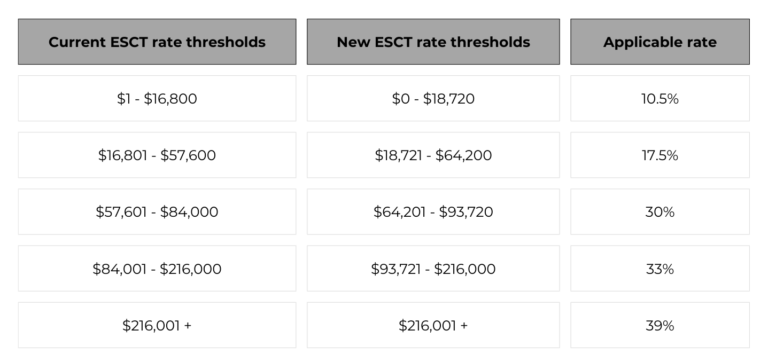
ESCT thresholds
ESCT stands for Employer Superannuation Contribution Tax. Typically you’ll see this as the tax that is applied to the employer contribution for KiwiSaver. These thresholds are increasing from 1 April. Nothing you need to do here – this is only really noticeable if you look at how the employer contribution is split between this tax and the net value the employee receives to their KiwiSaver.
Tax on extra pays
The IRD has specified a new method for calculating the thresholds used to determine the tax rate used for lump sum payments when they relate to the end of employment. These specifications are currently in draft, so we may still see further changes – this can be somewhat confusing and we recommend you reach out to our payroll team for assistance when you have a final pay to calulate.
——————
Please contact our payroll team if you need any support or advice.